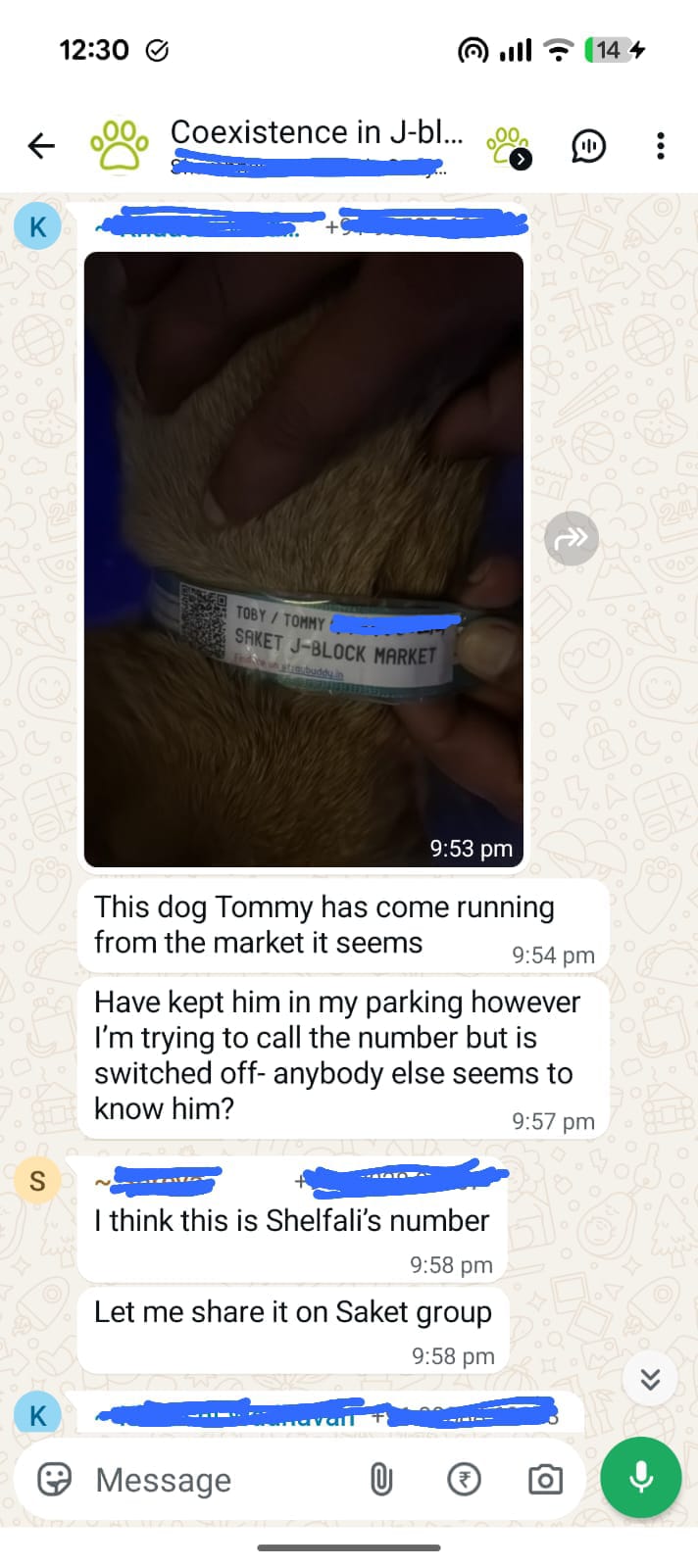
It was 11:35 p.m. on Diwali night. The celebrations had just wound down, and I was scrolling through my phone, catching up on festive wishes from friends and family. Amidst those messages, there were a few messages on the neighbourhood community group as well. I opened the chat casually to see what was going on. Someone had shared that a scared dog had come running into their parking area. Attached was a photo of him, trembling in a corner. I zoomed in on the picture and spotted a QR coded tag with my own handwriting in the phone number written on the collar he wore around his neck.
Over the past month, I’ve been assisting the Stray Buddy team run collaring workshops to help caregivers across Delhi. At the heart of this work is the Stray Buddy webtool, an online database ideated and created by the team’s founding members, that currently maps entire community dog populations across roughly 30 neighbourhoods in the city. On the tool, each individual dog has a digital QR coded profile containing their name, photograph, the community area along with their landmark or lane they belong to, their sterilization status, their last anti-rabies vaccination date and caregiver names.
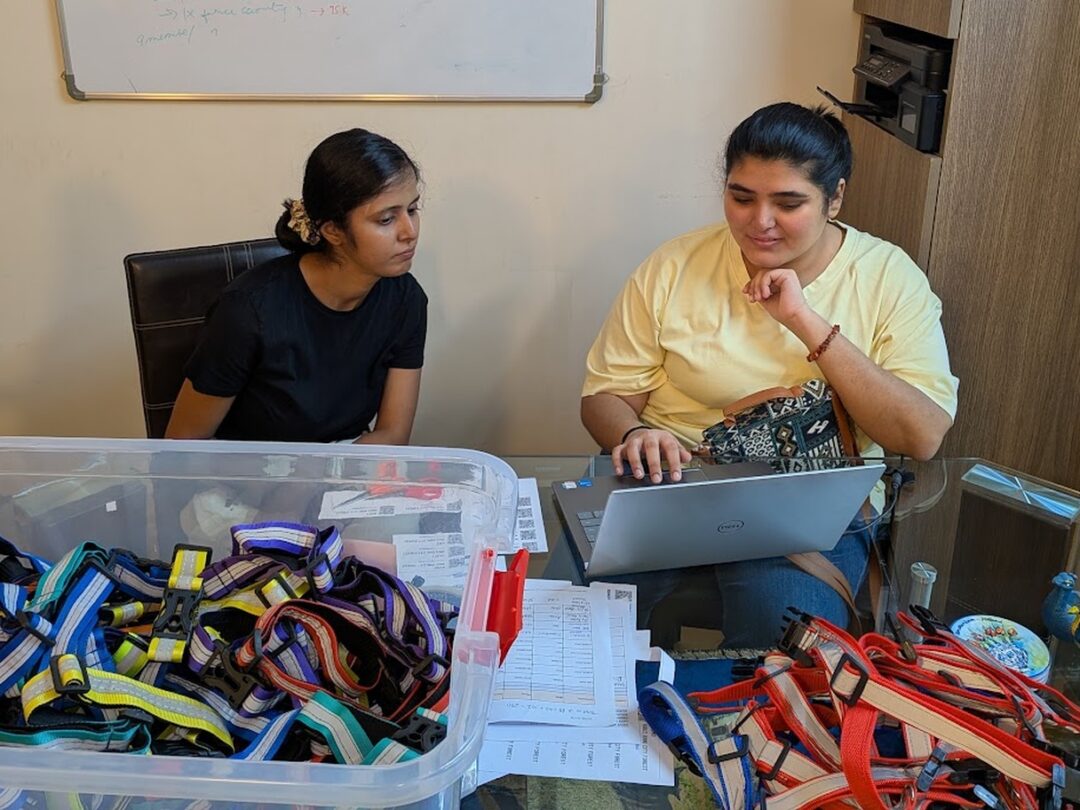
Recently, a new feature was built into the webtool to utilise all that digital mapping one step further. With a single click, the tool pulls a dog’s mapped data to generate a printable, customized tag that can be put around their neck collar. Each tag carries a unique QR code that links directly back to that dog’s live online profile, alongside the dog’s name, their locality, and a blank space to manually write the emergency phone number of the caregiver who looks after them. Over casual cups of tea during our Do-It-Yourself (DIY) workshops last month, volunteers and community animal caregivers spent time printing these tags, cutting them out, laminating them with tape, and fitting them onto collars.
Anyone who has a pet, takes care of any community animal or has simply noticed some furry members of the neighbourhood would be aware that dogs and other animals get scared of the loud explosive noise from firecrackers during festive seasons. Some caregivers have even reported the dogs in their communities running all the way away over 7-8 kms in fear and panic triggered by the loud explosions. Scared dogs running in panic are at a risk of being run over by vehicles, losing the way back home and not knowing how to get back, getting into territorial fights with other dogs and getting bitten or injured.
Usually, a panicked dog ending up in a new neighbourhood is completely anonymous. The QR tags are an idea designed to solve that exact problem. If a dog gets lost, anyone with a smartphone can now scan the code to see their details, including vaccination history and home territory or simply dial the handwritten number to reach someone the dog trusts.
Back to the Diwali night, as the whatsapp chat kept unfolding and I saw my own handwriting on that dog’s collar and how the person who found him trembling with fear was able to calm him and call up the person whose number I had manually written on the collar last evening, I felt the impact of what I had unassumingly helped with. Because of that simple tag I had taped together over tea, the resident who found the trembling dog didn't have to guess where he came from or wonder if he was safe to approach. He had a name, a neighbourhood and a direct contact to the person whose number I had scribbled, allowing them to calm him down and help him get back to his lane safely.
As I sat there holding my phone with goosebumpy arms, another quiet realisation came to me. When any of us are caught in a sudden or fearful situation, our only instinct/wanting is to get back to our safe space, to get home. And how frightened that dog must be when the sky suddenly started bursting with firecrackers noises that he couldn’t have understood. He ran in panic and got lost. But he would’ve just wanted to feel safe too and to be able to come back to his familiar street, his home.
This one moment suddenly made me realise the weight of that small action of mine. I rationally “knew” why we were spending hours mapping profiles and taping collars... I literally made dozens of them in the past few weeks, doing all the printing, cutting and taping with caregivers and other team members. But seeing that photo genuinely made me feel the deep importance of what a small, structured effort can mean. It also made me smile, feeling empowered in a teeny, tiny way that something so simple could alleviate another being's distress.
And I just sat there wondering if this, too, is part of what celebrating Diwali is about…in just being able to help another soul, looking out for a quiet, innocent non-human neighbour who had no say in the noise around him, and simply helping him find his way back home. I felt so glad that this collar tag could literally make the distressing experience a little lighter, a little safer and maybe even life saving for that one doggie! (And so for many others like him)
Yes, living alongside community dogs in a bustling city isn't always easy and friction happens. Yet, coexistence has always been a quiet part of our everyday culture. Finding ways to make urban spaces safer and more comfortable for both humans and animals doesn't always require grand gestures. Sometimes, it just takes a bit of thoughtful data, a few neighbours coming together over tea, a strip of tape, and a handwritten phone number, to turn good intentions into something practical that collectively creates a larger impact!